How to Measure Community Engagement on Reddit
How to measure community engagement on Reddit starts with a reset: a post with a high score is not automatically a high-quality outcome. The useful version of engagement measurement looks at comment depth, repeat participation, follow-up questions, and whether the thread helped you learn something actionable about the audience, the message, or the product.
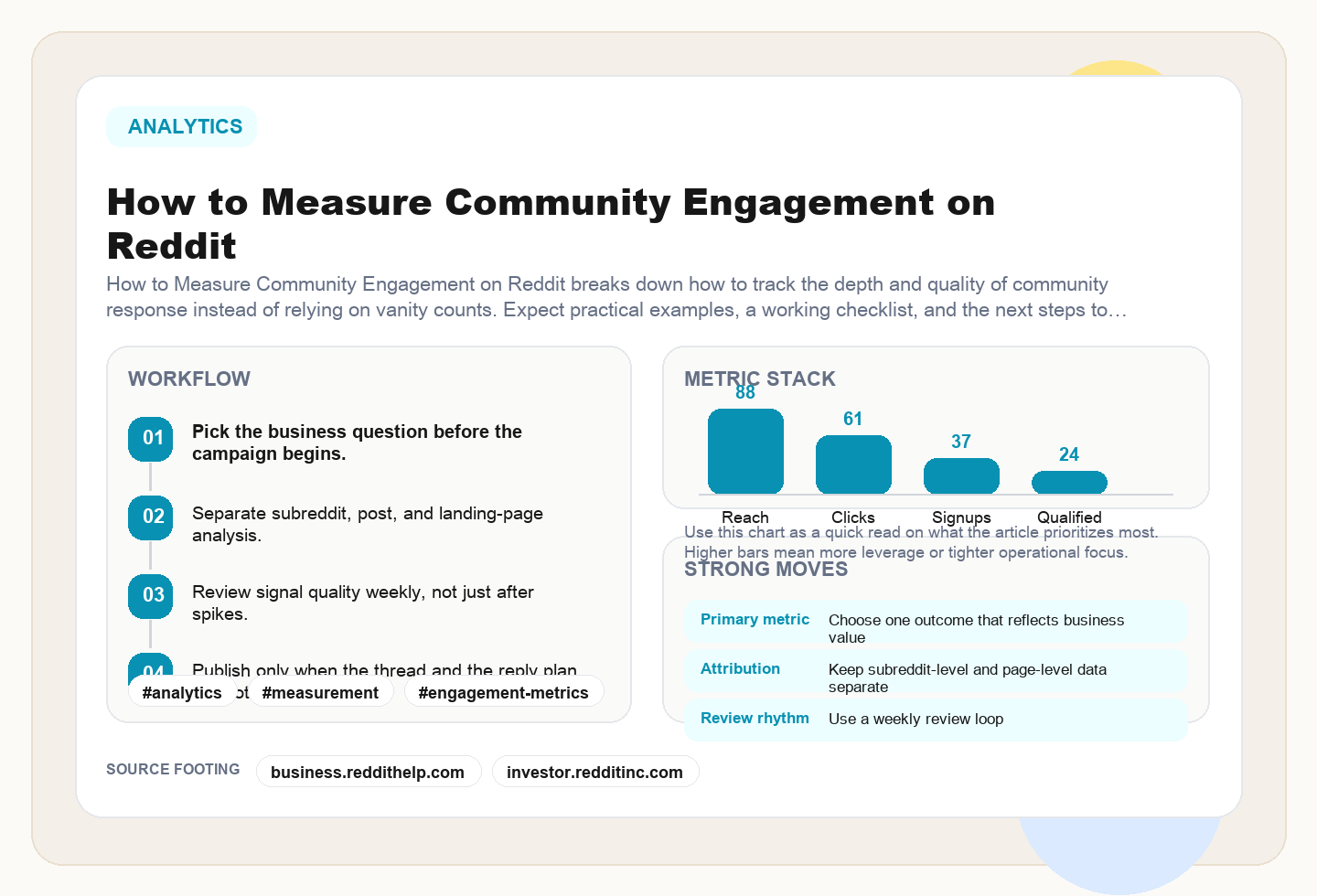
Source-Backed Context
Reddit's Help documentation says post sorting includes Hot, Top, New, Relevance, and Comment Count, and it explicitly describes Comment Count as the view for posts with the most discussion. That matters because Reddit itself distinguishes between popularity signals and discussion-heavy signals. Source
Reddit's business attribution docs also explain that attribution is about credit for actions influenced by a channel and that the default setup can include 28-day click-through and 1-day view-through attribution. Engagement analysis gets stronger when you compare on-platform discussion with what happened after the thread, not just in the thread. Source
Reddit's conversion-event documentation lists downstream actions like Page Visit, View Content, Search, Lead, Sign Up, and Purchase. That is useful because a discussion can be successful in more than one way: stronger community response, better traffic quality, or clearer downstream intent. Source
What Does Community Engagement Actually Mean on Reddit?
Community engagement on Reddit means more than people reacting to a headline. It is the quality of the discussion that follows: how specific the replies are, whether people add their own examples, whether the same users come back to continue the thread, and whether the post generates useful next questions. A thread is engaged when it produces signal, not just motion.
That is why vote count alone is a weak proxy.
Votes tell you that something landed.
They do not tell you why it landed, whether the right audience saw it, or whether the response is useful for future decisions.
Use this distinction:
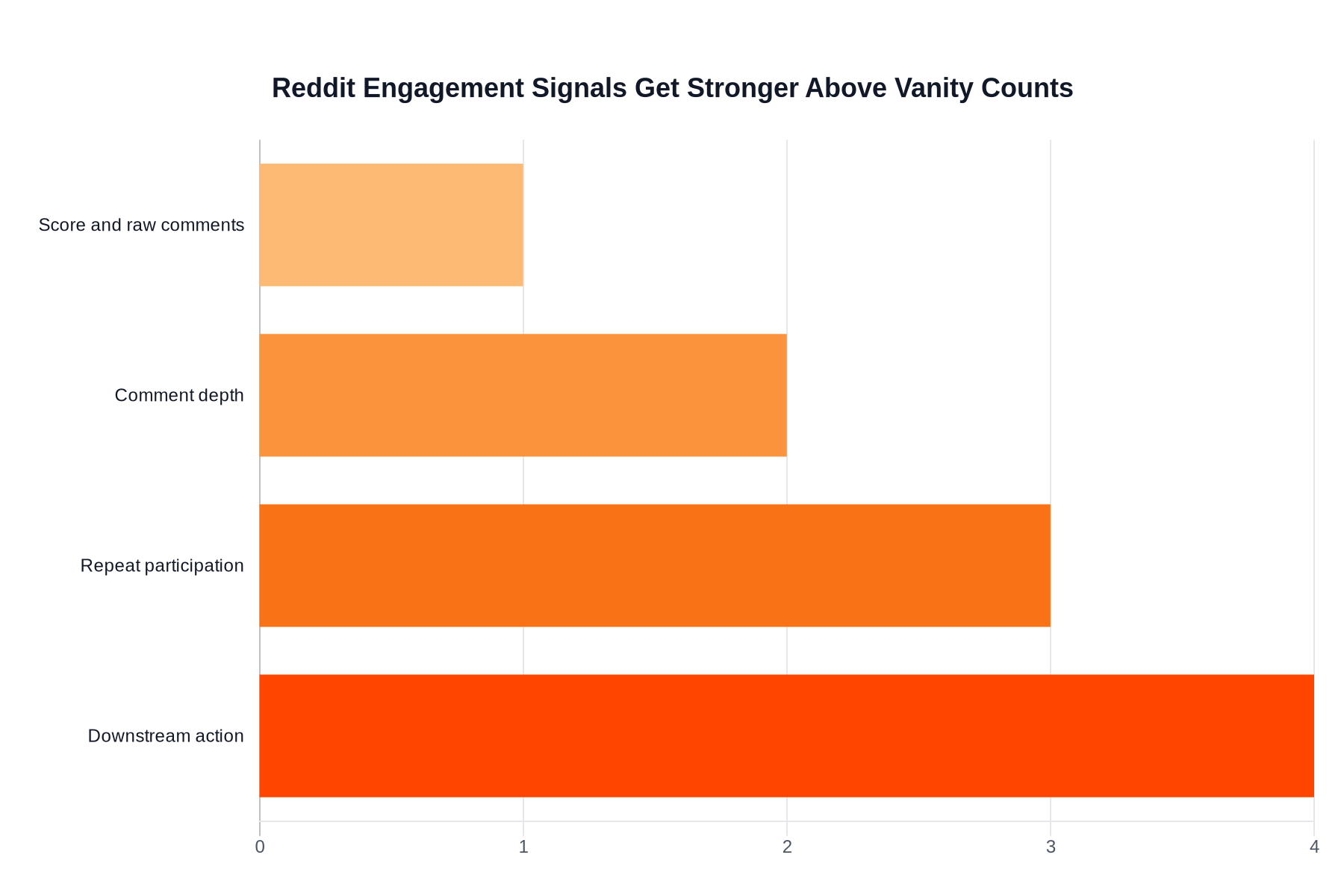
| Signal type | What it usually shows | Why it matters |
|---|---|---|
| Score and raw comments | Surface-level attention | Useful context, weak explanation |
| Comment depth | How much thinking people invested | Better indicator of real engagement |
| Repeat participation | Whether the thread kept the same people involved | Helps identify durable interest |
| Follow-up action | Whether readers clicked, searched, or asked for more | Connects discussion to business value |
If you need the business-outcome layer after this, move next to Reddit Marketing KPIs That Matter and How to Track Reddit Referral Traffic.
Which Metrics Matter More Than Vanity Counts?
The best engagement metrics on Reddit usually describe discussion quality, not just discussion volume. A smaller thread with high-signal replies is often more valuable than a larger thread filled with low-commitment reactions.
That is the core reporting upgrade.
Stop asking only how many comments a post received.
Start asking what kind of comments those were.
A useful starter stack looks like this:
| Metric | What to measure | What it helps you decide |
|---|---|---|
| Comments per post | Total visible response | Whether the topic attracted enough attention to analyze |
| Comments with specific examples | Replies that include workflow, tool, or problem details | Whether the thread reached people with real experience |
| Questions back to the poster | Clarifying or implementation questions | Whether the audience wanted more depth |
| Distinct engaged users | Unique users who added meaningful replies | Whether the discussion was broad or concentrated |
| Repeat responders | Users who returned later in the same thread | Whether the post sustained discussion |
This is also where How Reddit Comments Influence Search Visibility matters. Better comments can improve the usefulness of the thread both inside Reddit and outside it.
How Should You Read Comment Depth?
Comment depth is one of the cleanest ways to distinguish curiosity from real engagement. A short thread full of one-line reactions may still be useful, but it usually tells you less than a thread where people explain their process, tradeoffs, or objections. Depth creates interpretability.
The easiest approach is to grade replies by depth, not sentiment alone.
Use a simple rubric:
| Comment type | Example pattern | Reporting meaning |
|---|---|---|
| Low-depth reaction | "Nice post" or "Totally agree" | Attention without much learning value |
| Medium-depth reply | Short opinion or lightweight disagreement | Some signal, limited reuse |
| High-depth reply | Includes examples, constraints, process, or tool comparisons | Strong learning value |
| Decision-shaping reply | Changes how you would message, build, or target | Highest operational value |
That rubric works especially well on posts about strategy, tooling, launches, and product feedback.
For adjacent analysis patterns, pair this article with How to Analyze Top Posts in a Subreddit and How Founders Use Reddit for Feedback.
Why Does Repeat Participation Matter?
Repeat participation matters because it shows that the thread kept readers involved instead of just attracting a one-pass reaction. If the same users return with another question, clarification, or counterexample, the discussion is usually generating more trust and more real interest. Repeat participation is one of the clearest signs that a thread had staying power.
You do not need a perfect identity graph to use this.
You only need to notice whether the thread drew one-off reactions or ongoing interaction.
This is the practical frame:
| Pattern | What it suggests | Likely next step |
|---|---|---|
| Many one-time reactions | Broad visibility, weak depth | Improve the next post's specificity |
| Fewer but repeat commenters | Strong topic fit and sustained attention | Revisit the topic with a follow-up post |
| Repeat participation plus follow-up questions | Qualified audience interest | Route the topic into content, sales, or product work |
| No repeat interaction after the launch window | Weak staying power | Recheck subreddit fit or post framing |
This is also why How the Reddit Algorithm Works and A First-Hour Engagement Plan for Reddit belong near this guide. The launch window affects whether a discussion has time to deepen.
How Should You Interpret Different Thread Types?
Different Reddit thread types should be judged differently. A feedback request, a builder story, and a comparison post will not produce the same shape of engagement. If you use one engagement standard for every format, you will misread good threads as weak ones and weak threads as good ones.
Use format-aware interpretation:
| Thread type | Good engagement looks like | Weak engagement looks like |
|---|---|---|
| Feedback request | Specific pain points, requested features, edge cases | Vague advice with no repeated themes |
| Builder story | Process questions, comparisons, lessons from similar builds | Praise or skepticism with no detail |
| Comparison post | Readers add alternatives and decision criteria | Brand arguments without explanation |
| Educational teardown | Clarifying questions and real-world implementation examples | Passive agreement only |
That makes the review much more actionable.
A thread can underperform on volume and still be a success if the comment type matched the goal.
For example, a smaller but sharper thread may be exactly what you want for Reddit Marketing for SaaS or Reddit Growth for DevTools Companies.
What Weekly Review Should You Run?
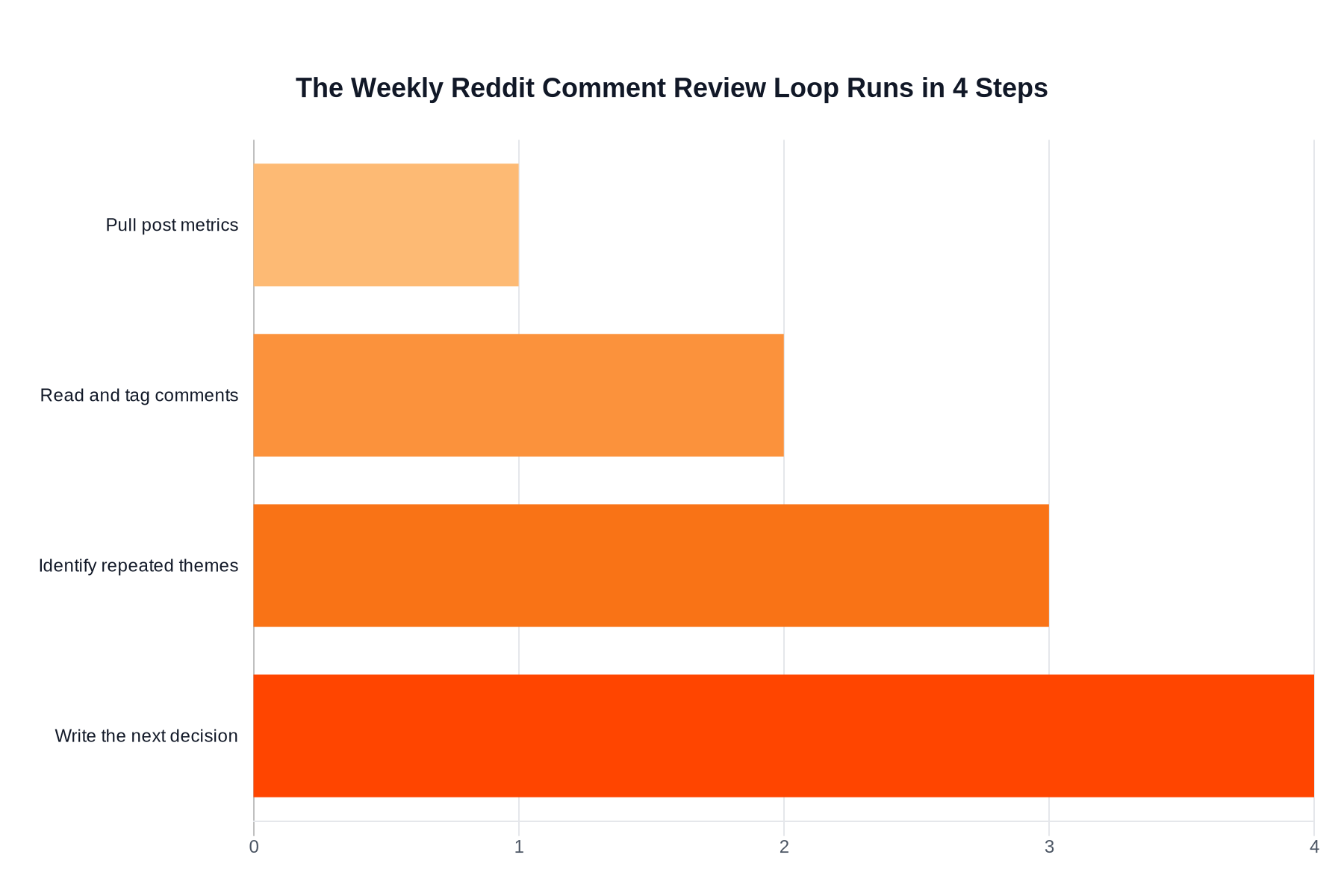
A weekly engagement review should answer three questions: which posts produced useful discussion, which ones produced misleading noise, and what the team should test next. If the review ends without a change in behavior, the measurement layer is too passive.
Run a compact weekly loop:
- Pull the week's posts and their core engagement metrics.
- Read a sample of comments, not just the totals.
- Tag comments by depth, objections, and useful next questions.
- Write one decision for the next post, one decision for messaging, and one thing to ignore.
This is where How to Build a Reddit Dashboard helps. The dashboard should reduce the time needed to see where to read more closely.
What Mistakes Break Engagement Reporting?
Most engagement reporting fails because teams confuse visibility with usefulness. If you only report what is easy to count, you will miss what is actually worth learning from.
The recurring mistakes are:
- treating score as the headline metric for every thread
- counting comments without checking what kind of comments they were
- ignoring repeat participation and only looking at first-wave activity
- comparing different thread formats with one uniform benchmark
- failing to connect thread quality with downstream traffic, search, or pipeline signals
If you avoid those five mistakes, your engagement reporting becomes much more credible.
And once the reporting gets clearer, the next improvement usually comes from better prompts, sharper topics, and better subreddit choices rather than more spreadsheets.
About the author
Mike
Editorial lead for Reddit growth and buyer-side education
Mike writes practical breakdowns on buying Reddit upvotes, comparing providers, and spotting the quality signals that matter before you place an order.