Subreddit Size vs Engagement: The Tradeoffs
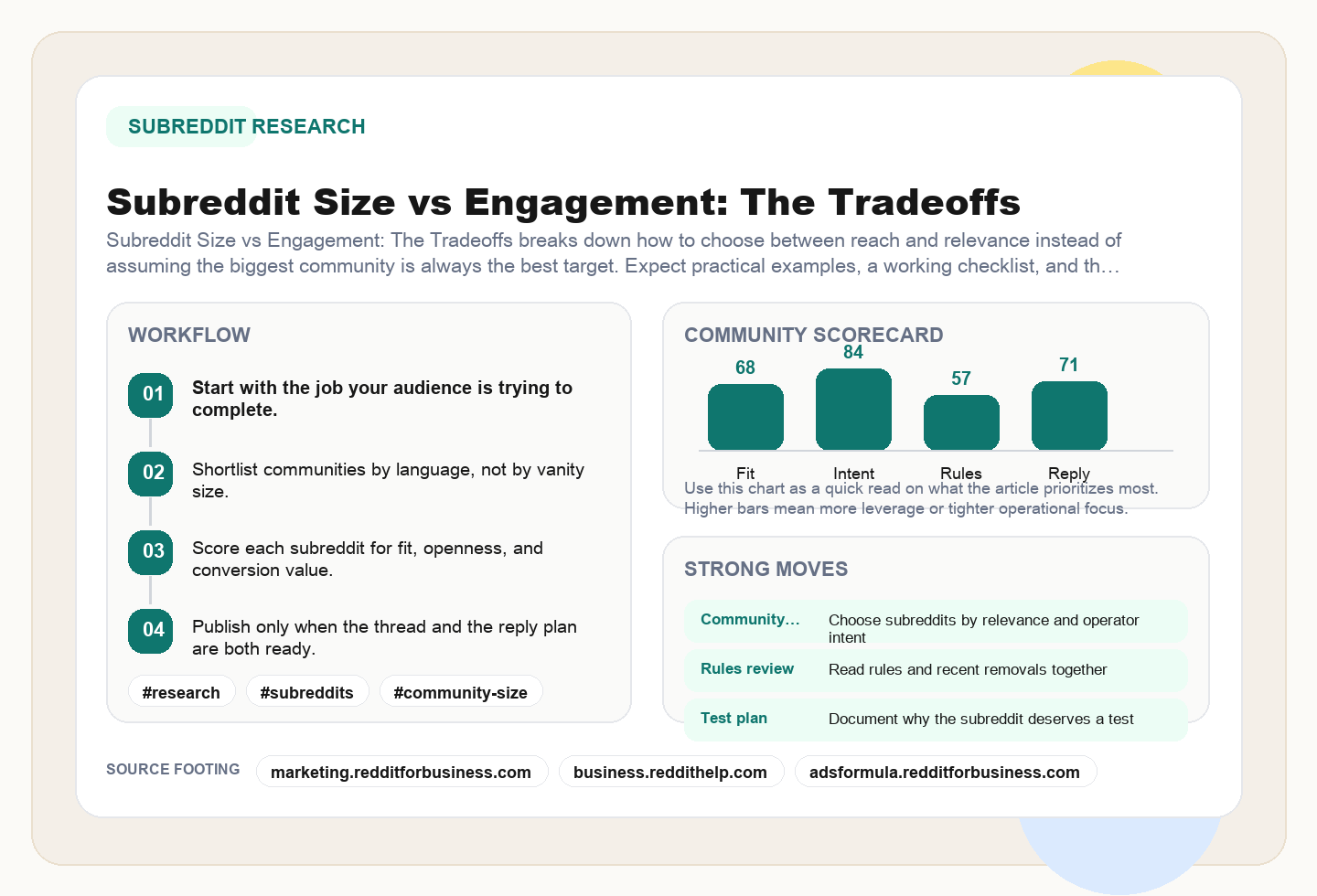
Subreddit size vs engagement is really a question about reach versus relevance. Large communities give you more potential exposure, but smaller communities often give you slower feeds, better fit, and more qualified discussion.
That is the core tradeoff.
If you choose by subscriber count alone, you usually overpay in effort for weaker replies and faster feed decay.
Source-Backed Context
Reddit is big enough to support both broad awareness communities and highly specific niche subreddits. Reddit Investor Relations says that as of December 31, 2025, Reddit had 121M+ daily active uniques, 471M+ weekly active uniques, and 100K+ active communities. Source
That number matters because most categories do not have just one relevant subreddit.
They have layers.
Reddit Help also explains that communities can be public, restricted, or private, and that access and posting permissions vary by community type. Source
And moderators shape the real experience inside each one.
According to Reddit Help, moderators can remove off-theme posts, act on reports, and ban rule-breakers inside their communities. Source
So size is only one part of the decision.
The real question is what kind of participation environment that size creates.
Why Is Bigger Not Automatically Better?
Bigger is not automatically better because large subreddits usually come with faster feed turnover, broader audience mix, and more noise around your exact use case. A big community increases possible reach, but it often lowers precision.
That is why broad exposure can be deceptively expensive.
Your post competes against more formats, more casual readers, more timing pressure, and often more moderation volume. That makes it easier to get seen briefly and harder to generate the right discussion.
Use this baseline comparison:
| Community trait | Large subreddit | Smaller niche subreddit |
|---|---|---|
| Possible reach | High | Lower |
| Audience specificity | Lower | Higher |
| Feed speed | Faster | Slower |
| Noise level | Higher | Lower |
| Comment relevance | Less predictable | More targeted |
| Ease of learning patterns | Harder | Easier |
If your goal is pure visibility, size matters more.
If your goal is qualified replies, audience fit usually matters more.
For the upstream fit check, pair this with how to research a subreddit before you post.
When Do Large Subreddits Actually Win?
Large subreddits win when the topic has broad appeal and the format can survive a fast-moving feed. If your post is timely, easy to understand, and strong enough to earn quick interaction, a large subreddit can create much more top-of-funnel exposure than a niche one.
That makes broad communities useful for:
- mass-interest stories
- visually legible posts
- timely industry discussions
- awareness-stage conversations
- opinion or reaction threads that can travel fast
But there is a catch.
The post has to be right for the environment. Big communities punish weak fit quickly because the feed moves on fast and the audience mix is less forgiving. For the mechanics behind that, continue with how Reddit algorithm works in practice and how Reddit hot ranking works.
When Do Niche Subreddits Win?
Niche subreddits win when relevance matters more than raw exposure. If the goal is better comment quality, stronger operator feedback, or clearer purchase-adjacent discussion, a smaller community often performs better than a giant general-interest one.
That is especially true when the audience shares a role, workflow, or recurring problem.
In those environments, the thread does not need mass appeal.
It needs local credibility.
This is why smaller communities often outperform on:
- technical troubleshooting
- detailed tool comparisons
- practitioner discussions
- founder or operator feedback
- research-stage and evaluation-stage questions
If your audience is narrow and your topic is specific, smaller can be stronger. That is also why how to find high-intent subreddits and reddit marketing for B2B SaaS often point toward role-based communities instead of giant category ones.
How Do Feed Speed and Timing Change the Tradeoff?
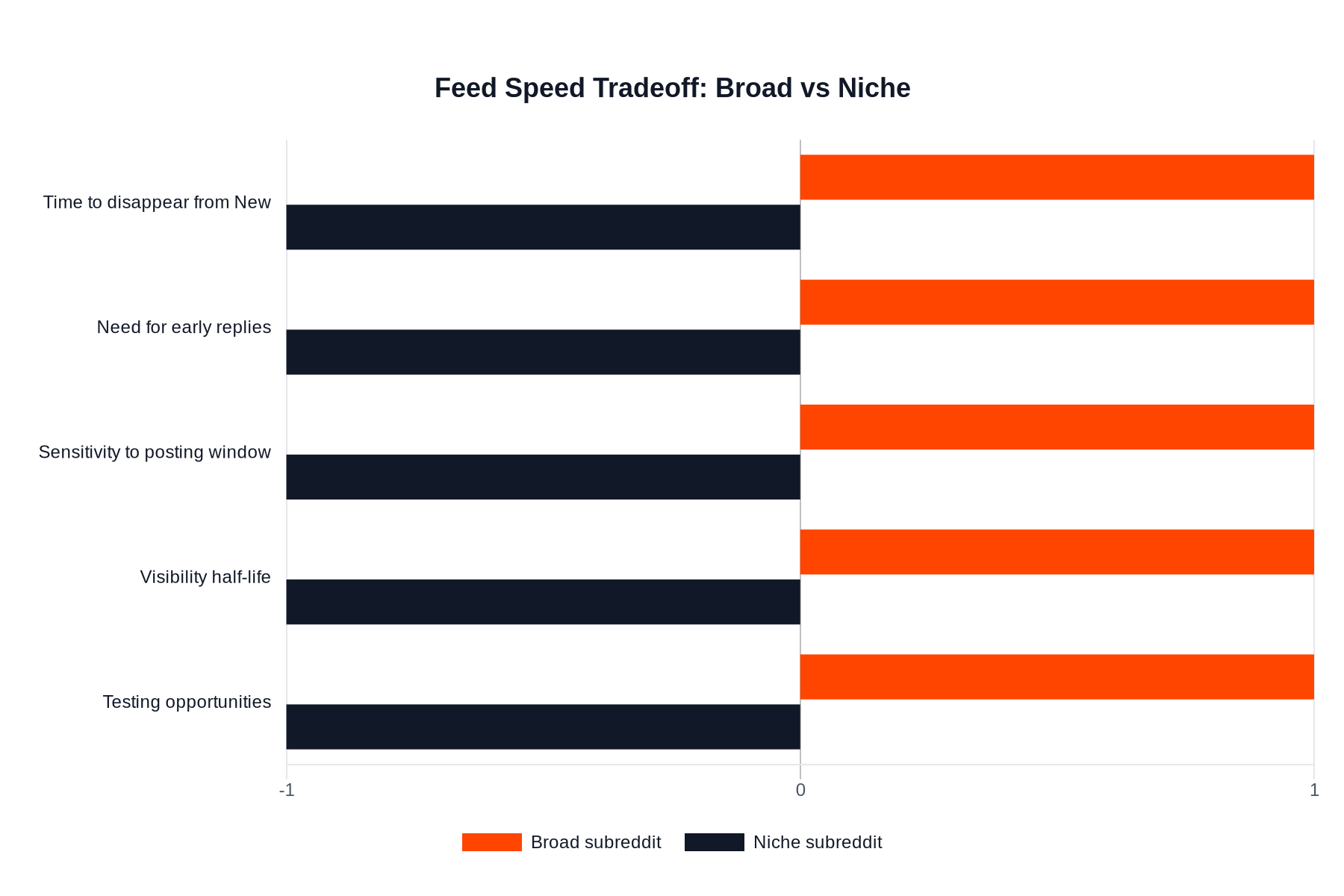
Feed speed changes how much room a post has to breathe. In large subreddits, weak early traction can bury a post quickly. In smaller communities, slower turnover can give a good thread more time to collect the right replies.
This is where timing becomes part of the size decision.
Reddit Help’s documented sorts make that visible: New emphasizes freshness, Hot emphasizes recent engagement, and Comment Count emphasizes ongoing discussion. Source
That means the same post can behave very differently depending on community size:
| Feed behavior | Broad subreddit | Niche subreddit |
|---|---|---|
Time to disappear from New |
Usually faster | Usually slower |
| Need for early replies | Higher | Still important, but less brutal |
| Sensitivity to posting window | Higher | Often more forgiving |
| Visibility half-life | Shorter for average posts | Longer for relevant posts |
| Testing opportunities | Higher volume, noisier signal | Lower volume, clearer fit signal |
This is why size and timing should be planned together, not separately.
For the timing layer, continue with best time to post on Reddit, how post timing changes by subreddit, and when to post to Reddit for launches.
How Do Comment Quality and Audience Relevance Affect the Choice?
Comment quality is where niche subreddits often pull ahead. A smaller community with better-fit readers can produce far more useful replies than a larger community with weak role alignment.
That matters because not all engagement is equally valuable.
Ten comments from the right practitioners can teach you more than a hundred reactions from casual readers. So when you compare communities, ask not just how many people might see the post, but how many of the right people are likely to answer in depth.
This is also where audience role matters.
If the subreddit brings together the exact buyers, operators, or users you care about, engagement becomes more diagnostic and more actionable. For the measurement side, continue with how to measure community engagement on Reddit and reddit marketing KPIs that matter.
How Do Rules and Moderation Load Shift the Risk?
Rules and moderation load often scale with community size. The larger the subreddit, the more likely you are to face stricter filters, heavier moderation, and less room for edge-case posts that need context.
That does not make large communities bad.
It makes them less forgiving.
Reddit Help explains that moderators can remove content that does not fit the community theme and that some communities are restricted or private, which also changes who can post or comment. Sources: moderator role, community types
In practice, that means:
- larger communities often require cleaner rule fit
- restricted communities may cap who can participate
- niche communities may allow more nuance if the post clearly belongs
- moderation behavior can matter more than subscriber count
This is why you should compare rules and moderation patterns before deciding that a giant subreddit is the obvious target. Pair this section with subreddit rules audit checklist and how to avoid post removals on Reddit.
How Should You Score Broad and Niche Communities Side by Side?
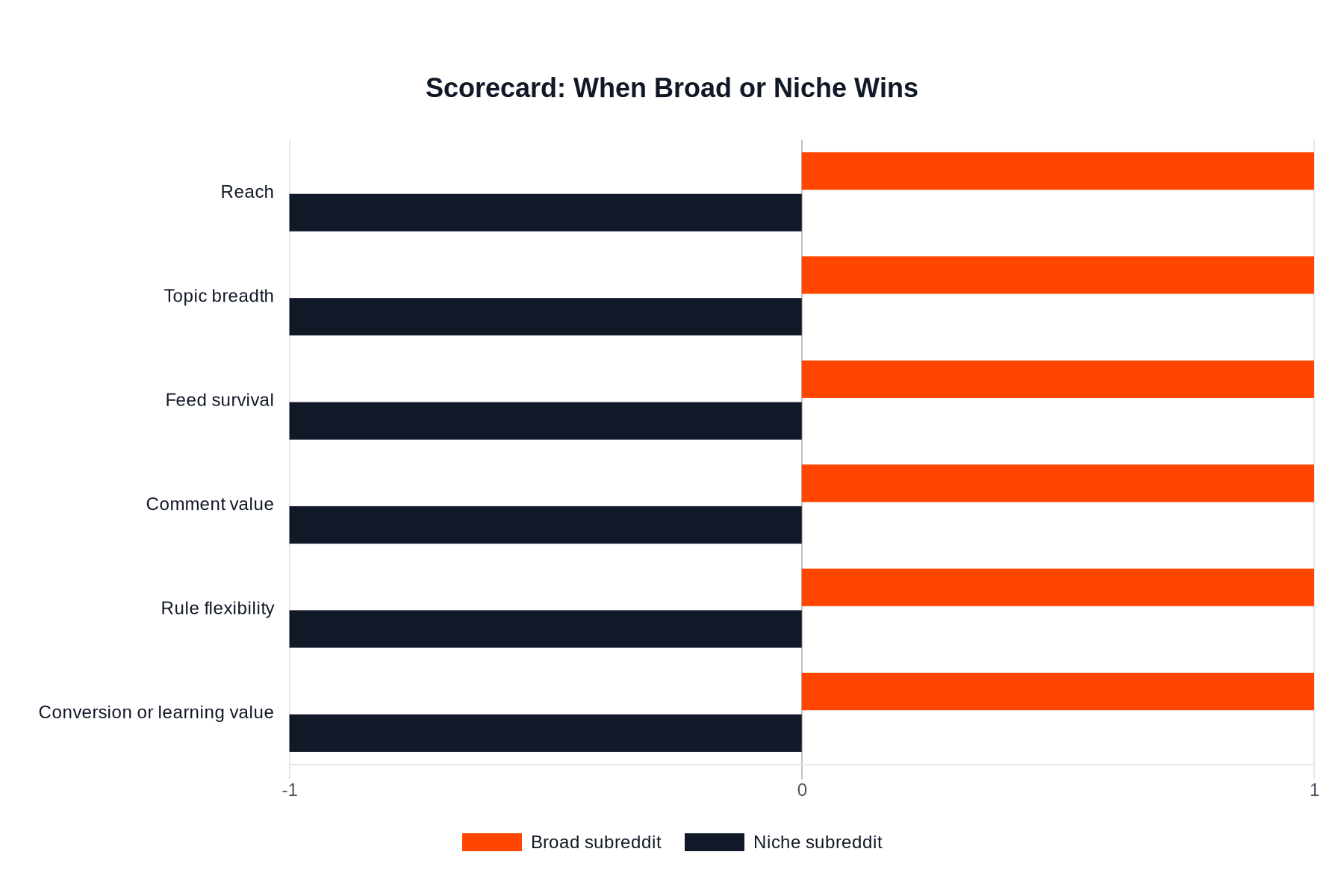
The simplest way to compare subreddit size tradeoffs is to score reach, fit, and friction together. If a broad subreddit wins on reach but loses badly on fit and friction, it may still be the worse choice for your actual goal.
Use a side-by-side scorecard:
| Factor | Broad subreddit wins when... | Niche subreddit wins when... |
|---|---|---|
| Reach | You need top-of-funnel visibility | You need the right people, not the most people |
| Topic breadth | The subject has wide appeal | The subject is specialized or role-specific |
| Feed survival | The post can earn quick early traction | The post needs more time to find the right readers |
| Comment value | Any discussion is helpful | Specific operator feedback matters |
| Rule flexibility | The post clearly matches mainstream community norms | The post needs nuance and local context |
| Conversion or learning value | Broad visibility is the main KPI | Qualified replies or action closeness is the main KPI |
This kind of scorecard makes the choice less emotional.
It also keeps the team from defaulting to the biggest name-brand subreddit every time. If you need the content-pattern layer too, use how to analyze top posts in a subreddit.
What Is the Practical Recommendation?
The practical recommendation is to start with the smallest subreddit that still contains the right audience and meaningful activity. Choose broad communities when you truly need scale. Choose niche communities when you need clarity, qualified discussion, or tighter fit.
That is the safer default because it gives you cleaner signal first.
Then you can expand outward.
A good sequence looks like this:
- Start in the niche community where the problem is most specific.
- Learn the title, timing, and comment norms there.
- Adapt the angle before testing a broader subreddit.
- Compare discussion quality, not just score or impressions.
That progression turns subreddit size into a deliberate strategy choice instead of a vanity bet. For the next steps, continue with how to find high-intent subreddits, how to analyze top posts in a subreddit, and how to track Reddit referral traffic.
About the author
Mike
Editorial lead for Reddit growth and buyer-side education
Mike writes practical breakdowns on buying Reddit upvotes, comparing providers, and spotting the quality signals that matter before you place an order.